
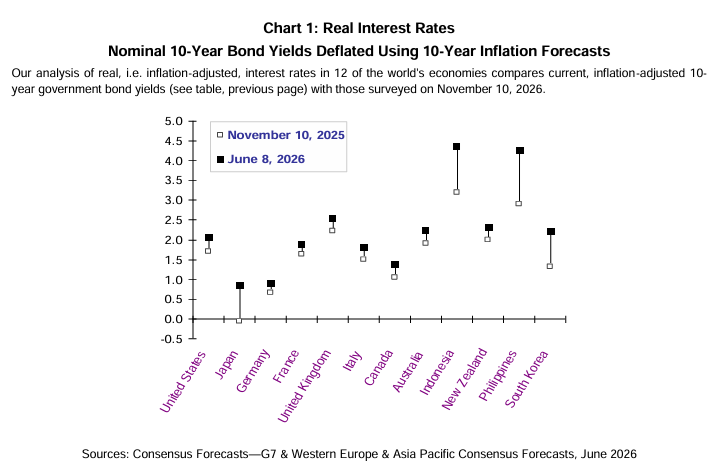
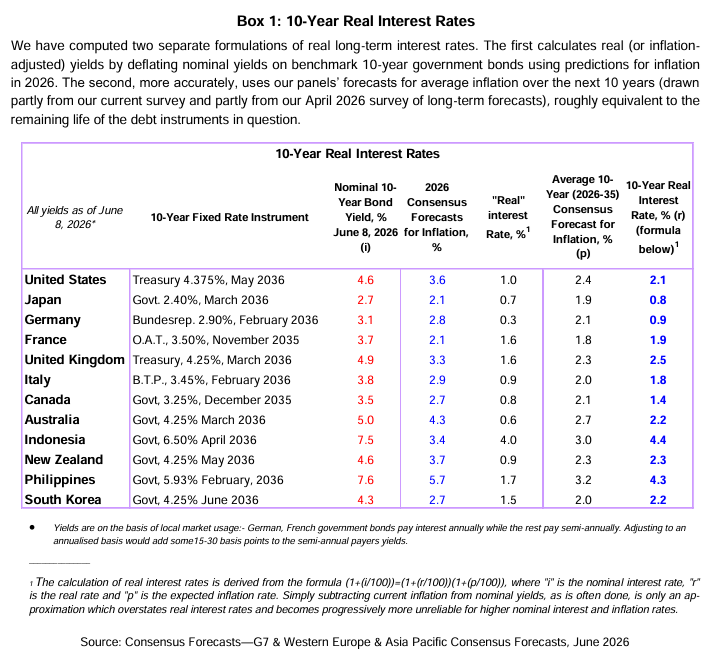
This article on trends in nominal and real bond yields for in the US, UK, Japan, Germany, France, Italy, Australia and Indonesia was originally published in Current Economics: June 2026
Trends in Nominal and Real Bond Yields Across Some Selected Economies
Consensus Economics, London
In the aftermath of the 2008 global financial crisis, central banks embarked on a decade-long experiment of cutting policy rates to near zero and launching large-scale quantitative easing (QE) bond-buying programs, to encourage borrowing, investment, and spending in the financial system. As central banks loosened policy and purchased large quantities of government bonds, the price of these bonds were pushed higher and yields declined throughout the 2010s. Weak growth and subdued inflation reinforced expectations that interest rates would remain low for an extended period. As a result, government bond yields in many major economies fell to historical lows, with some European sovereign yields turning negative. Notably, this meant that borrowing during the COVID-19 pandemic utilised super-cheap rates.
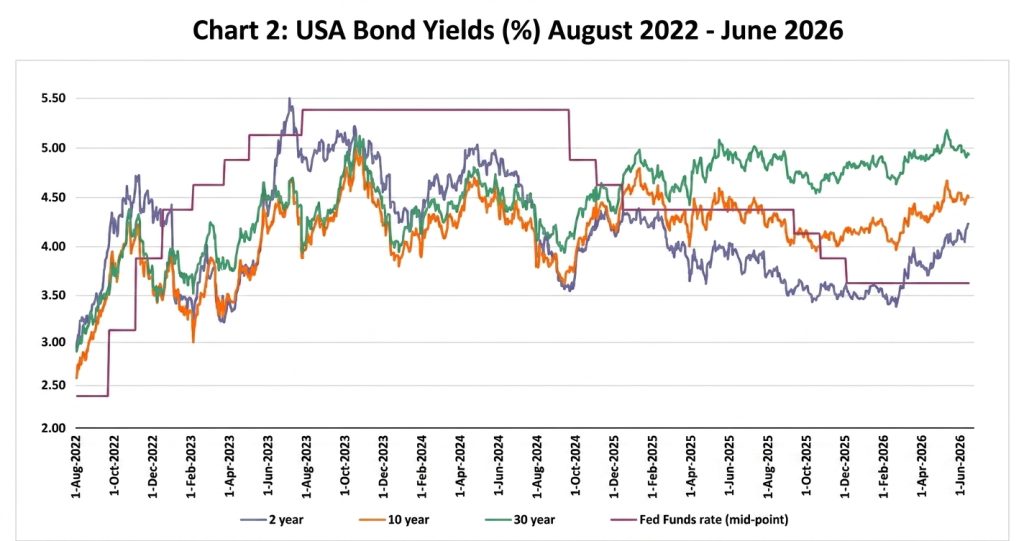
In February 2022, Russia escalated its conflict with Ukraine into a full-scale war. What followed was central banks executing the fastest, most aligned global interest rate hikes in decades to combat soaring, energy-driven inflation. Bond yields surged higher throughout 2022 and 2023 as investors adjusted to a higher-for-longer interest-rate environment. Rising inflation and expectations that central banks would maintain restrictive monetary policies kept upward pressure on yields. More recently, conflict in the Middle East prompted the closure of the Strait of Hormuz; subsequent disrupted trade and energy supply sparked a new wave of inflation, driving 10-year bond yields across major economies to reach levels last seen during the 2008 financial crisis.
USA
Is US borrowing sustainable?: The US government, the largest borrower in the world, has consistently run big deficits over several decades, requiring the US Treasury to continuously issue debt securities to refinance maturing obligations and fund additional spending. As inflation and interest rate expectations have risen since 2022, investors have increasingly questioned how sustainably the US can finance its expanding debt burden without relying on looser monetary policy in the future. If debt monetisation were to occur through sustained money supply expansion, inflationary pressures would intensify and become even more imbedded than they are currently. This would require higher nominal bond yields to preserve real returns for investors.
Bond issuance and bondholders: At the same time, demand dynamics within the T-bond market have become less supportive. Foreign investors now account for a much smaller share of the Treasury market than in the late 2000s, when overseas holdings peaked at roughly 55% of marketable US government debt. The share of foreign investors dropped to roughly 30% in 2025, with countries such as China and Japan having gradually reduced their relative exposure, not to mention the US-Israel war on Iran triggering a wider selloff. Japan, the largest foreign holder of US treasuries, has seen its own long-dated bond yields reach the highest level in recent history, diminishing the incentive to buy US bonds.
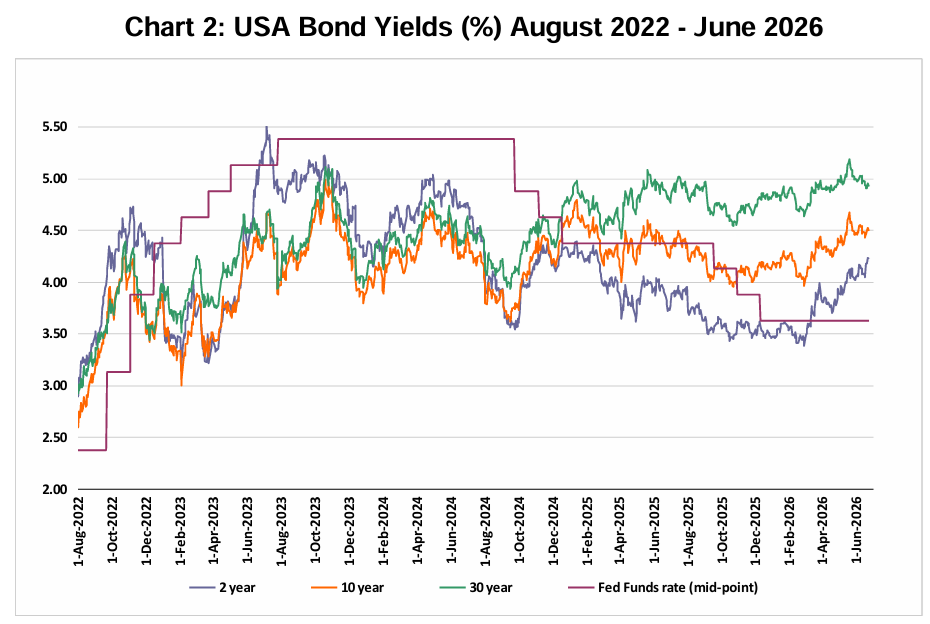
The rise in US nominal yields: In addition, uncertainty has increased around US government policies. The US government has shifted borrowing towards short-dated securities in order to reduce immediate refinancing costs and ease pressure on long-term yields. However, this increases refinancing risks by leaving a larger share of debt exposed to elevated and volatile short-term interest rates. Consequently, long-dated treasury yields have continued to rise. The 30-year treasury yield recently went above the 5% threshold, which historically acted as a ceiling, for the first time since the 2008 financial crisis, reflecting persistent inflation concerns, growing fiscal pressures, and reduced confidence that long-term borrowing can remain at present levels.
JAPAN
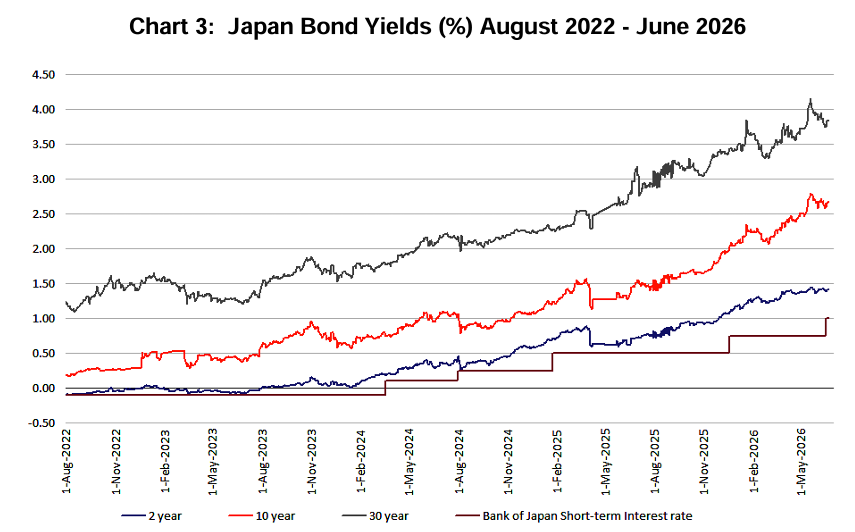
Fiscal Dynamics: The Bank of Japan only reversed negative policy rates in March 2024, but has since recorded the steepest rise in sovereign bond yields across the G7, heavily magnified by its historically low baseline. Following Prime Minister Sanae Takaichi’s landslide victory in February’s snap parliamentary elections, bond yields jumped as investors grew concerned about the fiscal impact of her pro-stimulus economic agenda. In particular, bond observers were worried about a promise to suspend consumption tax for two to three years thereby depriving the state of some much needed tax revenues. Japan has the biggest gross government debt burden as a percentage of GDP within the G7. In the months following her appointment, Japan officially shifted away from its single-year primary balance surplus target, adopting a multi-year medium-term framework focused on stabilising the debt-to-GDP ratio.
Energy imports and demographics: The energy crisis was expected to place a heavy strain on Japan, with more than 90% of Japanese crude imports coming through the Strait of Hormuz. Real bond yields have actually outpaced the nominal bond yields in recent months, as government energy subsidies cause inflation to retrench. Perhaps most specific to Japan, shorter maturities have risen moderately compared to super-long yields. Ageing demographics concurrently play a major role in a shrinking tax base and rising welfare costs, which will necessitate additional government borrowing on top of a more expansive fiscal policy. In May, the 30-year nominal bond yield reached 4.1%, its highest since it began trading.
UK
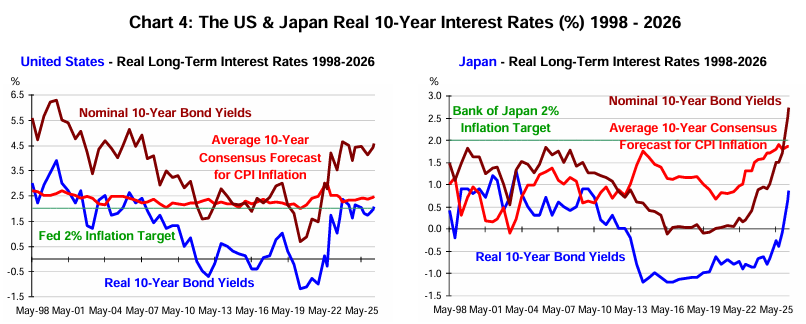
Why the UK cannot borrow like the US: The 10-year gilt yield recently surpassed the 5% level, following a global rally in bonds due to the energy crisis. But universal factors fail to explain why the UK currently faces the highest borrowing costs within the G7. For example, the fiscal outlook of the UK is certainly worrying, but countries such as the US, Japan, and France have higher debt-to-GDP ratios. UK bond markets did not really regain the confidence of investors after the disastrous Truss-Kwarteng mini-budget in October 2022. Meanwhile, inflation has certainly impacted the UK, yet while inflation has moderated, bond yields remain elevated, and of late, US inflation has overtaken the UK’s.
Profile of gilt holders: One plausible explanation for the UK’s higher premium is its lack of safety nets. It has neither the dollar’s reserve-currency advantage nor institutional and fiscal frameworks like the ECB’s Protection Instrument affords to Euro zone states. Gilts, therefore, reflect closer to market-clearing prices than other countries’ borrowing costs. Second, the change in gilt-holder profile has possibly been more substantial that the rest of the G7. The Bank of England’s transition to quantitative tightening occurred at a time when UK insurance companies and pension funds shied away from gilts. New buyers (other financial institutions and overseas investors) are more price-sensitive and demand greater compensation when lending money.
Political Stasis: With current leadership uncertainties, bond markets are assessing the implications of whether Rachel Reeves will remain as Chancellor, and will maintain a commitment to fiscal conservatism. April and May’s softer inflation outturn of 2.8% (y-o-y), and the end of the Middle East war has helped push the nominal bond rate below 5% once again. Even so, the UK will have to contend with higher borrowing costs until investors are provided with clearer political direction.
GERMANY, FRANCE & ITALY
German debt dynamics: Increased defense spending has been a major point of discussion within Europe following the Russian invasion of Ukraine. When Germany
shifted away from its debt brake and towards fiscal stimulus for defence and infrastructure spending, it prompted a surge in debt issuance. This record net supply of debt forced the market to adjust borrowing costs to absorb the heavy volume. Italy and France also saw their bond yields jump at the same time, and thus defence has had little impact on the spread between each of these countries. Instead, other internal factors have dictated differences in borrowing costs.
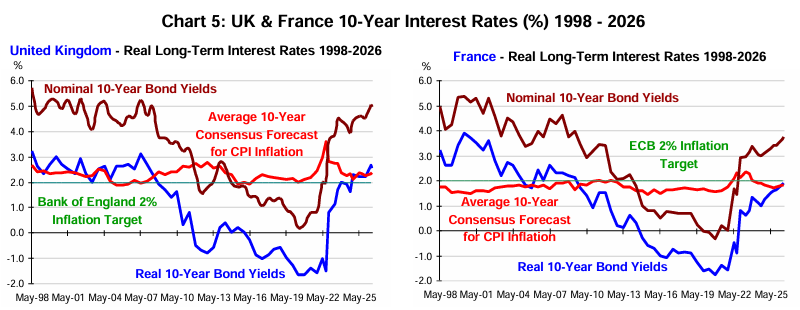
France and Italy: The spread between French and Italian bond yields has been narrowing for years, but were at their closest when political deadlock in France came to a head in September 2025. Since then, French yields have remained slightly below Italian yields, but 2026 saw France’s budget deficit expected to remain at -5.1% of GDP. It seems unlikely that state spending will be addressed even after next year’s presidential election, given that no main political party is expected to cut spending. The country has suffered downgrades from various credit rating agencies. Meanwhile, Italy has a much higher debt-to-GDP ratio, but over the past two years has been able to rein in its government budget balance to almost comply with the European Union’s fiscal rule for members states of -3%. However, Italian debt has fallen a bit out of favour in 2026, following the strong inflation surge given its greater reliance on external energy, and Prime Minister Georgia Meloni’s setback in a recent constitutional referendum, though the country remains politically stable. Both countries’ 10-year bond rates are slightly below the 4%-bound, though real yields are higher in France. German bond yields remain below the other major Euro zone economies, with the 10-year under the 3% mark, though they are beginning to lose their safe haven status owing to a structural change in the fixed income market.
AUSTRALIA & INDONESIA
Asian energy exposure: The trend of rising real and nominal bond yields seen within the G7 economies is shared with Asia Pacific. Some factors are, however, more noticeable for some economies. For example, although Australia entered the post-pandemic period with comparatively lower public debt than many advanced economies, persistent inflation pushed government bond yields to their highest level in a decade. The impact of the war on inflation was more prominent within Asia Pacific, due to greater reliance on energy imports from the Middle East. Inflation in Australia peaked at 4.6% (y-o-y) in March, before easing slightly to 4.2%. Investors anticipate that the Reserve Bank of Australia may need to maintain tighter monetary policy for longer.
Current accounts are a factor: Another factor, which has not yet been mentioned, is the correlation between a country’s current account and its borrowing costs. Australia, along with the UK, US, and New Zealand, runs a current account deficit, which contrasts with many European countries and Canada which run current account balances close to zero or are in surplus. All four countries in the first group have higher bond yields than their positive-current-account counterparts. Indonesia’s currency crisis and bond yield surge are also due to a significant widening of its current account deficit, owing to higher energy prices.
Indonesia in the spotlight: The Indonesian government which had already committed to large spending plans, has stepped in with costly subsidies. Worries over fiscal discipline, along with centralisation of strategic commodity exports, is only half the reason the bond markets are concerned. The other half is explained by fears over Bank Indonesia’s independence. A recent legislative overhaul was introduced broadening the central bank’s policy goals to include stimulating job creation and economic growth, while granting lawmakers increased oversight over the institution and its leadership. Furthermore, recent interest rate hikes and holding of the reserve money growth objective at 10%, indicates bringing the currency back in line is a more immediate priority than appeasing the bond markets.