Track forecast revisions
Follow changes in consensus expectations more frequently than the standard monthly publication cycle.

Monitor changes in professional economic expectations between monthly survey dates and integrate structured Consensus Economics data directly into research, modelling and internal data workflows. Structured for automation, quantitative research and AI-enabled workflows.
*Database access depends on the client subscription.
Continuous Consensus Forecasts combines regular survey data with forecast revisions collected between monthly publication dates. The result is a more current view of how professional expectations are moving through time.
Follow changes in consensus expectations more frequently than the standard monthly publication cycle.
Use consistently structured CSV data for repeatable extraction, model updates and one-off research projects.
Panellist tracking mnemonics support deeper work on contributor histories and forecast accuracy research.
The premium API service provides consistent structural identifiers alongside the forecast data, making it easier to integrate recurring updates into internal research systems and analytical processes.
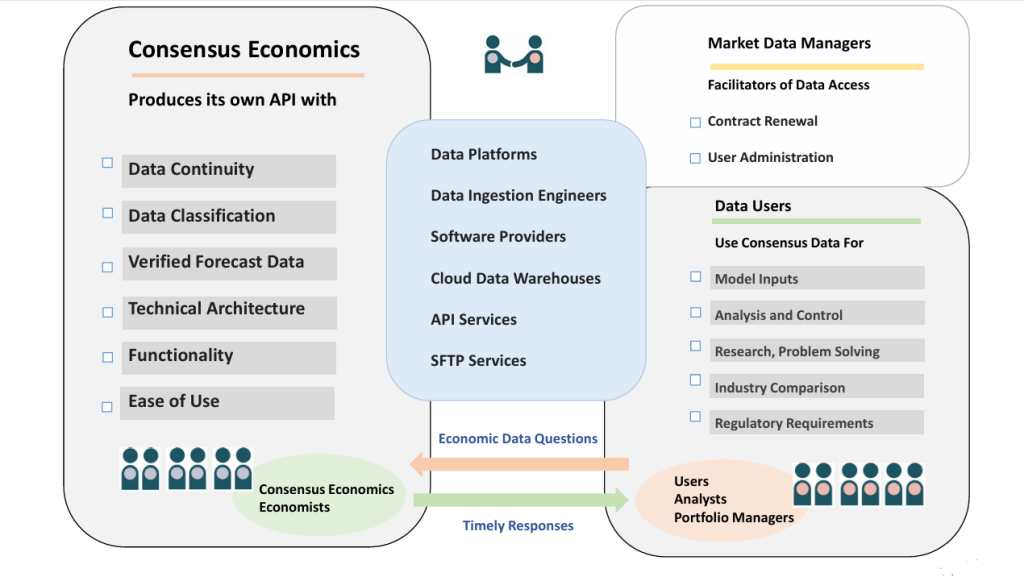
The service is intended for clients with their own technical capability. It works with common command-line, scripting and programming environments.
Both services provide Consensus Economics data, but they suit different research workflows.
Core Consensus Forecasts follow a regular monthly survey cycle. Continuous Consensus data are available through the API for users who need to monitor changing expectations between the main monthly survey dates.
Yes. The service uses structured identifiers and repeatable CSV output designed for recurring extraction, model updates, quantitative research and AI-enabled workflows.
Yes. Panellist tracking mnemonics support work on contributor histories, forecast behaviour and accuracy research as well as analysis of the consensus itself.
The API uses a REST architecture with structured CSV output designed for recurring extraction and integration into production workflows.
Access depends on the databases included in your subscription. A single API key can provide access across subscribed datasets rather than requiring separate credentials for each one.
Review a full sample of the underlying forecasts first, then order access to the forecast service you need.