
In addition to their annual forecasts, we regularly ask our country panellists to provide long term economic forecasts 3-10 years out from the survey date. We undertake these special surveys across our publications Consensus Forecasts – G7 and Western Europe, Asia Pacific Consensus Forecasts, Latin American Consensus Forecasts and Eastern Europe Consensus Forecasts.
Long Term Economic Forecasts in Excel
We have broadened our coverage of Long-Term Consensus Forecasts by making them available in Excel format and API. The files contain historical survey data going back to 1989 for some countries, and include forecasts of GDP growth, Consumption, Investment, Consumer Prices and Interest Rates, among others. These databases are split into four regional modules (see table below), covering a total of 89 countries (30 new countries have been added since 2019 – full list of these new additions within the table below).
These files are re-surveyed for data revisions four times a year (in January, April, July and October). For more information on our Long-Term forecasts databases in Excel, please contact us at editors@consensuseconomics.com.
Country Coverage
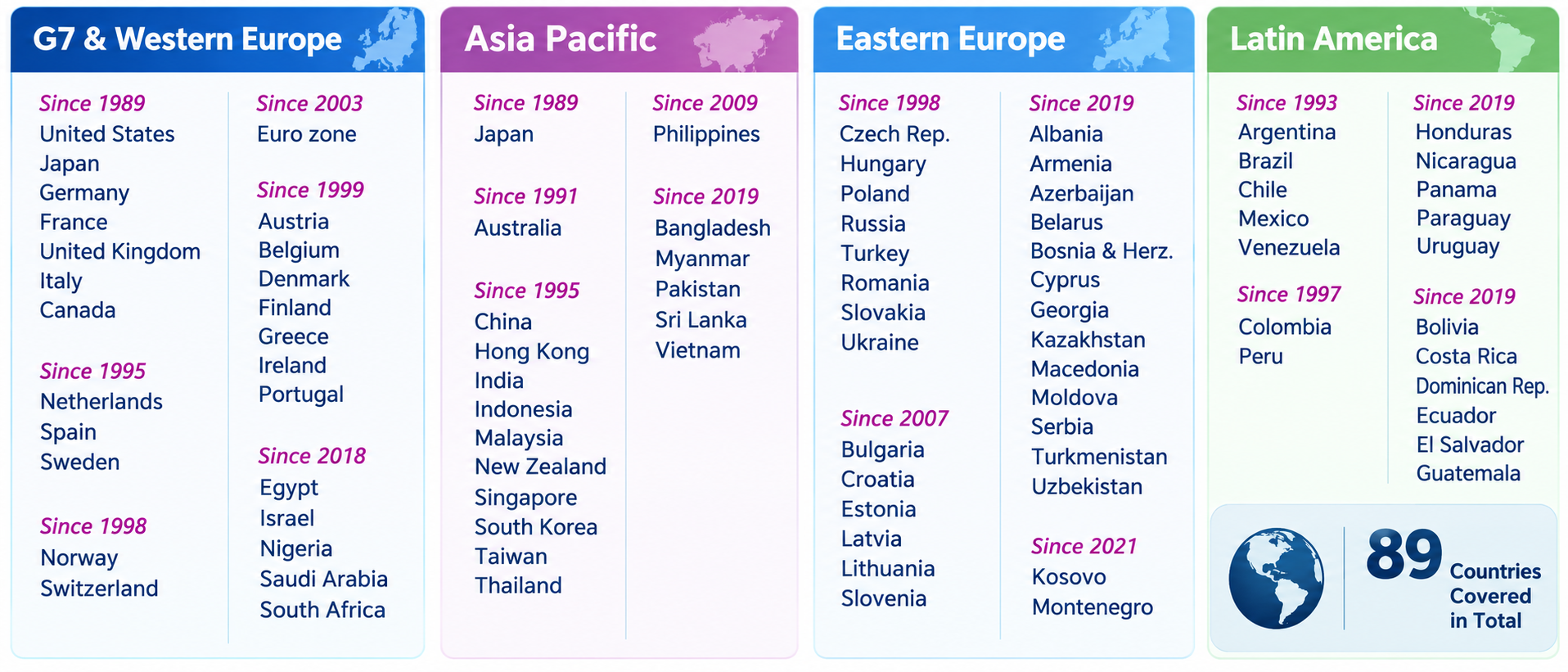
New countries included in our Long-Term Forecasts coverage from April 2019:
Asia Pacific region: Bangladesh, Myanmar, Pakistan, and Sri Lanka.
Eastern Europe region: Albania, Armenia, Azerbaijan, Belarus, Bosnia & Herzegovina, Cyprus, Georgia, Kazakhstan, Kosovo, North Macedonia, Moldova, Montenegro, Serbia, Turkmenistan and Uzbekistan.
Latin America region: Bolivia, Costa Rica, Dominican Republic, Ecuador, El Salvador, Guatemala, Honduras, Nicaragua, Panama, Paraguay and Uruguay.
Trends in Long Term Economic Forecasts
A relatively recent study conducted by M. Kose, F. Ohnsorge and N. Sugawara (2019) titled “The Growth Forecast Puzzle” investigates the increasing pessimism over forecasts for the long-term economic outlook. The authors examine the historic trends in Long-Term Consensus GDP Growth Forecasts and how they may offer insight into the current state of the global economy.
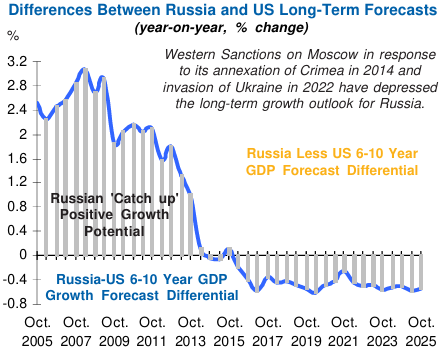
The chart below shows trends in Long-Term GDP Growth for Russia taken from our Eastern Europe Consensus Forecasts publication in October 2025.
Fiscal Vulnerabilities and Trade Concerns
Heightened global economic uncertainty continues to shape long-term expectations for Central and Eastern Europe. Through disruptions to financial, trade, and commodity price channels, geo-political developments – most notably the prolonged war in Ukraine – continue to expose the region to security risks and sustained energy dependence on Russia. The Moscow-EU/US relation remains fragile, and the return of Cold War–style politics threatens to negatively impact the dynamics of an increasingly multipolar world.
The situation is exacerbated by the economic underperformance of Western Europe, particularly in Germany and France, which has affected exports and foreign direct investment. Combined with increases in the cost of living, most governments have struggled to contain rising debt costs and implement essential reforms. EU membership (and eventually euro adoption) had previously been viewed as a gateway to faster growth and higher productivity. However, while Croatia joined the single-currency bloc two years ago and Bulgaria appears poised to follow suit in January 2026, the commitment to convergence at the expense of policy independence appears less certain among other countries. Caution partly reflects fragmented trade dynamics, EU budget disputes and the perceived lagged policy response of the ECB to recent crises, which have prompted a reassessment of membership benefits. The ability to retain monetary flexibility is increasingly seen as an important policy tool for responding to exogenous shocks.
The extent and nature of future challenges – whether in renewables, infrastructure, or technology – will likely vary across countries, particularly given US tariffs and competition from Asia. In Poland, the economy is forecast to expand 3.3% in both 2025 and 2026, supported by domestic demand. Likewise, a recovery in Hungary is predicted to gain momentum, with GDP growth set to accelerate to 2.6% in 2026. In contrast, panellists have become less optimistic about Romania, due to its high twin deficits (fiscal and current account) and elevated inflation. The consensus is predicting that the country will expand 1.0% in 2025, followed by 1.6% in 2026 and 2.6% in 2027. The pace of its eventual recovery will depend upon political stability, which remains a key source of uncertainty.
A portion of text from Eastern Europe Consensus Forecasts, October 20, 2025.