
In addition to our regular monthly surveys of projections for over 90 currencies we also undertake a special survey of currency trading ranges in Foreign Exchange Consensus Forecasts (in January) for the currencies listed below.
| G7 | Asia Pacific | Eastern Europe | Latin America | Africa |
|---|---|---|---|---|
| US Dollar | Australian Dollar | Russian Rouble | Argentinian peso | South African rand |
| Euro | Chinese Renminbi | Hungarian Forint | Brazilian Real | |
| Japanese Yen | New Zealand dollar | Polish Zloty | Mexican Peso | |
| UK Pound | South Korean Won | Turkish Lira | ||
| Canadian Dollar | Indian Rupee | Czech Koruna |
To download a sample issue of Foreign Exchange Consensus Forecasts please click on the button below or continue reading to learn more about this special survey.
Measuring Currency Volatility
All forex market participants recognize that currencies tend to fluctuate within trading ranges rather than moving smoothly from one level to another over time. Moreover, different currencies exhibit differing degrees of volatility. As a result, as well as their point forecasts for individual currencies, this month we also asked our panellists for their predictions of the likely ranges within which they expect a number of currencies to trade over the coming year. More precisely, our panellists are asked to provide their estimates of the quarterly ranges within which a number of major currencies are likely to trade over the next five quarters.
Currency Trading Ranges
Intense speculation over monetary policy direction at major central banks, and the imminent risk of a global economic slowdown, has meant FX volatility readings are much higher in our latest survey than a year ago. The consensus forecasts shown throughout this publication represent an average of our panellists’ central scenario of where exchange rates are likely to be at particular points in the future. However, these do not provide information on how currencies will likely fluctuate from one point to another over time. As a result, in addition to their point forecasts for individual currencies, this month we also asked them for their predictions of the likely ranges within which they expect a number of currencies to trade over the coming year. These ranges can be viewed as measures of likely volatility or risk associated with individual currencies. The expected ranges during Q1 2026 (measured as percentages of the consensus forecast for that quarter) are compared in the table below with other frequently used volatility measurements. Historical volatility measures the degree to which a currency has actually fluctuated over a defined period1. Implied volatilities are calculated by using currency option prices as a guide to the degree of volatility in a currency expected by the options market2. It should be noted that these measures are fundamentally different. Forecast ranges are the expected boundaries of currency movements over quarterly periods, while historical volatility is a measure of past day-to-day changes.

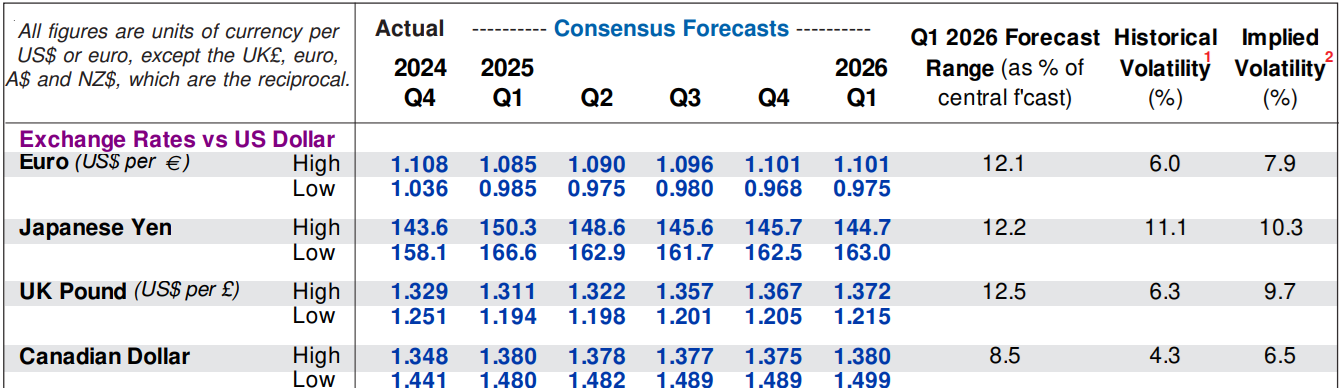
The charts and text above represent a small portion of this special survey taken from our January 2025 issue of Foreign Exchange Consensus Forecasts.